
 By Callum Fraser
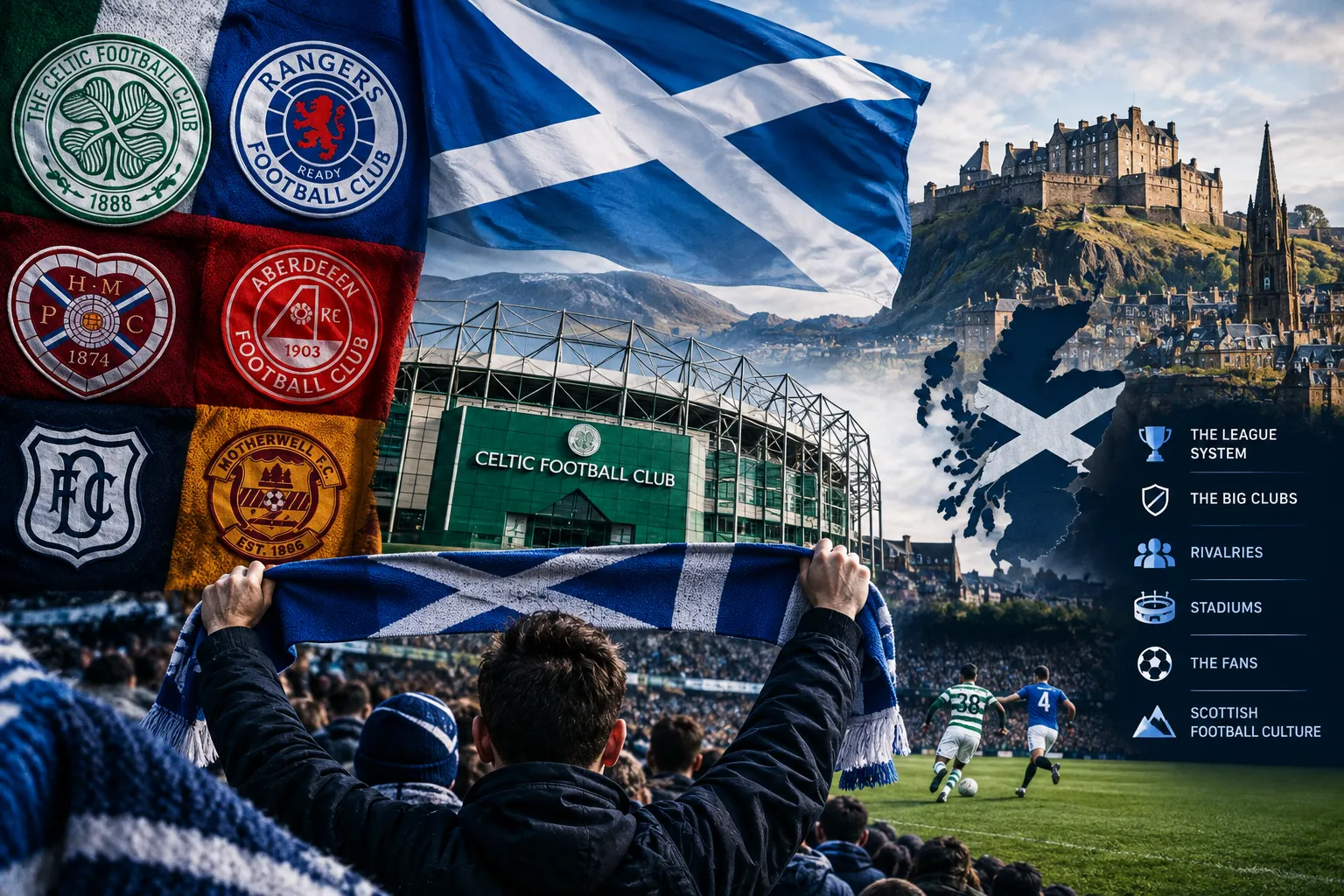
Scottish football is followed closely by the people inside it and misunderstood by almost everyone else. The league structure is unusual, the competitive balance is unlike anything in England, the cup competitions carry more weight than their equivalents elsewhere, and a surprising amount of what the English game takes for granted was exported north to south rather than the other way round.
This page is the overview of everything on this site. It explains how the game is organised, why the two Glasgow clubs occupy the position they do, what happens when Scottish sides reach Europe, what the country keeps producing, and how to follow and buy into it from anywhere. Each section links to the detailed piece, so you can go as deep as you want on any part of it.
How Scottish football is organised
Forty-two professional clubs, across four divisions. The Premiership has twelve, the Championship, League One and League Two have ten each, and that total has been remarkably stable for decades.
The top division runs a format nobody else uses: each club plays the others three times, then after thirty-three matches the league splits into a top six and a bottom six, with five further games inside each half and no movement between them. It is a compromise designed to produce meaningful fixtures in a small league, and it works better than its critics allow.
Below the professional game the structure goes sideways rather than down — two parallel leagues at the fifth tier, feeding in from different halves of the country, with a promotion play-off that only opened relatively recently. Our full guide to the Scottish football pyramid sets out how a non-league club can actually work its way up, and why so few manage it. The current structure and competition rules are published by the Scottish FA.
Why does the Old Firm dominate?
Two clubs from one city have won the overwhelming majority of Scottish league titles, and that fact shapes everything else — the competitive questions in a season, the distribution of money, the transfer market and the attention the league receives abroad.
The rivalry is not simply about football, which is why it has outlasted every attempt to explain it in football terms. The Old Firm derby explained covers where the two clubs came from, what the fixture is actually like, and why it still stops Glasgow. For the hoops themselves — one of the most copied designs in world football — see our guide to Celtic shirts.
Why do Scottish clubs struggle in Europe?
Money, mostly, and the gap has widened rather than narrowed. A Scottish champion now enters European competition against clubs whose wage bills are multiples of its own, and the qualifying rounds arrive early in the season when Scottish sides are least prepared.
The league structure contributes. A twelve-team division with a split produces a shorter, less demanding campaign than a twenty-club league, which is poor preparation for a two-legged tie against a side from a stronger competition. And the coefficient compounds it: poor results reduce the country’s ranking, which worsens the seeding, which produces harder draws.
None of which stops the good nights mattering more precisely because they are rare. Our piece on why Scottish clubs struggle in Europe sets out the finances and what would actually have to change.
The cups, where the gap closes
The Scottish Cup is the second oldest national cup competition in the world and has a better record of producing upsets than its size suggests. That is structural rather than romantic: the field is unusually wide, ties are single matches with an unseeded draw, and the conditions in a Scottish January close the gap by more than anyone likes to admit.
Why the Scottish Cup still produces upsets works through the reasons, including the fortnight of preparation a lower-league side gets against a Premiership club’s three days.
Attendances, which are better than almost anyone expects
One statistic consistently surprises people who dismiss Scottish football: measured against population, Scotland has among the highest football attendances in Europe. The two Glasgow clubs fill grounds in the fifty- to sixty-thousand range every fortnight in a country of around five and a half million, and clubs in towns of twenty thousand routinely draw four-figure crowds in the lower divisions.
That matters for understanding the league properly. The competitive problem in Scottish football is financial rather than cultural — the money available per supporter is limited by the size of the broadcast market, not by any shortage of people willing to turn up. It is why the clubs are more dependent on matchday income than their English equivalents, why season-ticket sales decide budgets, and why European revenue swings a club’s finances so violently.
It also explains the intensity of a fixture like the one above. A derby in a country where a very high proportion of the population actually attends is a different proposition from one in a league watched mostly on television.
Pitches, weather and the artificial surface argument
Visiting supporters notice immediately that Scottish football has far more synthetic pitches in its senior divisions than England does, including clubs that have played top-flight football on plastic for years.
The case for them is financial rather than sporting. A grass pitch in a wet Scottish winter needs drainage, undersoil heating and a full-time grounds team; an artificial one takes forty hours of use a week and turns the stadium into a facility that earns money seven days a week. Why Scottish clubs play on artificial pitches covers the economics, the player objections and where the evidence on injuries actually sits.
What Scotland keeps producing
Two things, consistently: wingers and managers. Neither is an accident, and both say something about how the game is played and taught in the country.
The winger tradition has survived every tactical fashion of the last fifty years, and why Scotland keeps producing wingers looks at the conditions that create it. The coaching export is the more remarkable of the two — a generation of Scottish managers reshaped English football, and the clubs they built still carry their mark, as why Scottish managers thrived in English football sets out.
Players followed the same route south. The rise of Scottish footballers in the Premier League tracks that movement, with the Scots who wore the Liverpool jersey and the Scots in the Arsenal kit covering two of the clubs that benefited most.
The national team and the oldest fixture in football
International football began with Scotland and England, in 1872, and the fixture is still the oldest in the game. It was also genuinely consequential: the two nations played in visibly different styles, and the Scottish passing game was the one that spread.
England versus Scotland tells that story, and for the two kits that meet in it, England’s football kit against Scotland’s compares them design by design.
Following Scotland away
The Tartan Army is one of the few parts of the national team’s story that has never had a lean spell, and its reputation — large numbers, good humour, substantial charitable fundraising and a tendency to be remembered fondly by host cities — is deserved rather than self-awarded.
The Tartan Army covers how it got that reputation and why the good humour survives results that would sour most support.
What should you know about buying football shirts from Scotland?
Two things, mainly: delivery and sizing. Most of the large kit retailers ship to Scotland without difficulty, but delivery windows to the Highlands and islands are longer than the headline figure suggests, and return windows are measured from delivery rather than dispatch — which matters if you are sending something back from a long way out.
Sizing is the usual trap. Buy on chest measurement rather than the size letter, which varies between suppliers and between a club’s home and third shirt in the same season. Our guide to buying cheap football jerseys from Scotland covers the practical side, and if you are looking for cheap football shirts that will last more than a season, construction matters far more than the badge.
For the national shirts themselves: the Scotland football shirt buyer’s guide covers the current cycle, Scotland retro shirts covers the eras worth collecting, and the England football shirt guide does the same south of the border.
English clubs with a Scottish following
Plenty of Scottish supporters follow an English club as well, and the three with the largest followings north of the border each have their own guide: Arsenal, Newcastle — closest geographically, and it shows in the away end — and Liverpool.
If you are buying for the design rather than the club, when football shirts became icons covers the ones that transcended their season.
Frequently asked questions
How many professional football clubs are there in Scotland?
Forty-two, across four SPFL divisions: twelve in the Premiership and ten each in the Championship, League One and League Two.
What is the Premiership split?
After thirty-three games the twelve clubs divide into a top six and a bottom six and play five further matches within their half. Clubs cannot move between halves after the split, whatever the points.
Can a non-league Scottish club be promoted?
Yes, through the pyramid play-off between the Highland and Lowland League champions and then the bottom League Two club. Several clubs have come up that way, though the licensing requirements are a significant barrier.
Are artificial pitches allowed in the Scottish Premiership?
Yes, provided the surface meets the required quality standard. Several clubs have played top-flight football on synthetic pitches, largely because the facility income makes them viable.