
 By Callum Fraser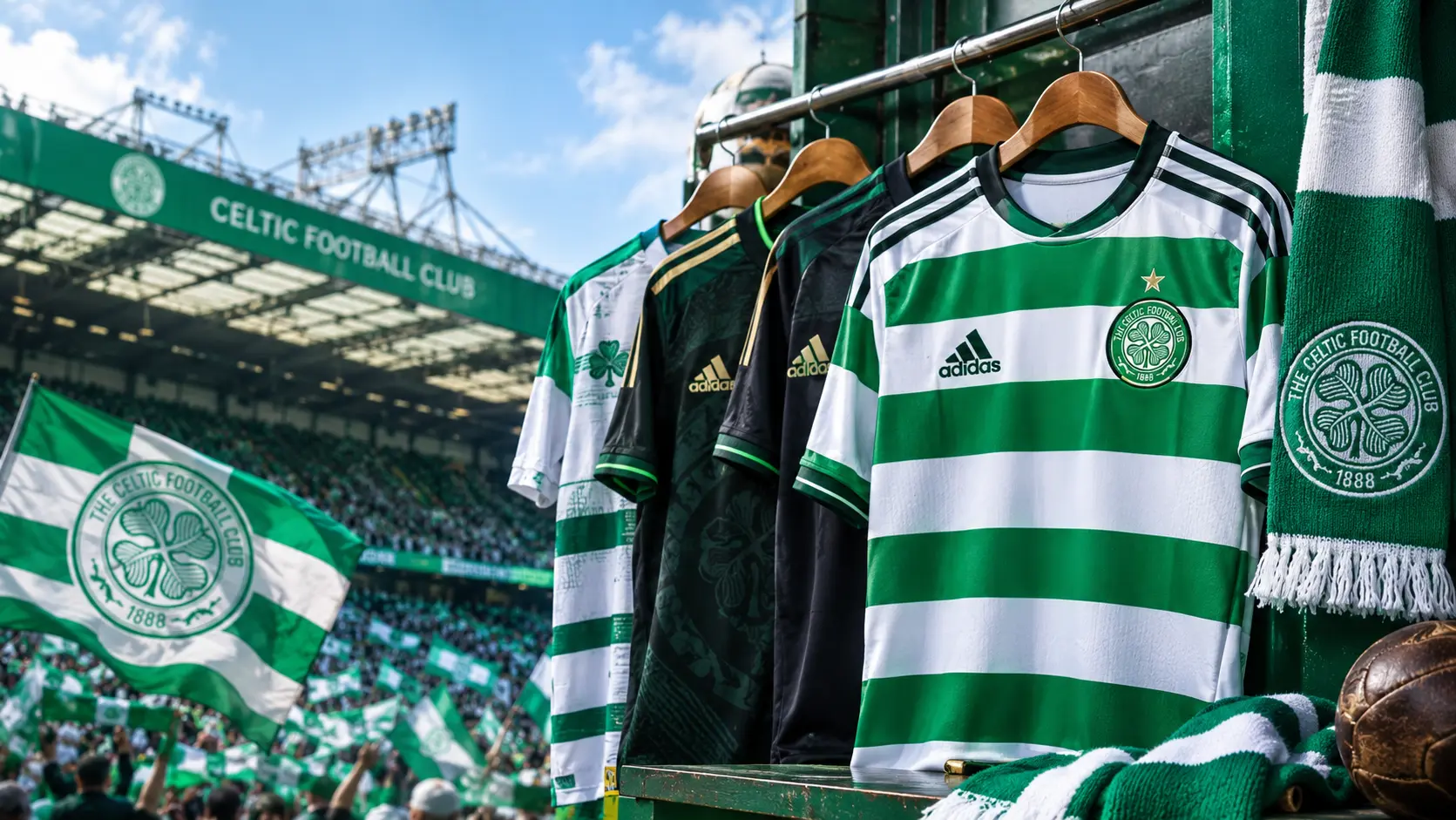
Very few clubs are identifiable from a single stripe of fabric. Celtic are one of them. The green-and-white hoops have been worn for well over a century, and the design is so strongly associated with the club that any horizontally hooped shirt anywhere in world football invites the comparison.
That makes buying one simpler in some ways and harder in others. There is no confusion about what a Celtic shirt looks like, but the hoops are also the easiest thing in football to get subtly wrong, and the differences between a well-made version and a cheap one show up more clearly on this design than on almost any other.
Where did the hoops come from?
Celtic did not start with them. The club’s earliest kit was white with a green collar, and in the years that followed it used green and white vertical stripes. The switch to horizontal hoops came in the early years of the twentieth century, and once it was made it stuck.
What has changed since is the detail rather than the idea. The number of hoops has varied, their width has varied, and the way the design meets the sleeve has varied — sometimes the hoops continue down the arm, sometimes the sleeve is plain white, sometimes it is green. Those variations are how collectors date a shirt, because the hoops themselves are a constant.
One other distinctive quirk is worth knowing. For much of the club’s history Celtic did not carry squad numbers on the backs of their shirts, using the shorts instead, on the reasoning that numbers broke up the hoops. The practice lasted into the nineteen-nineties, which is why photographs of great Celtic sides show unmarked backs.
The eras collectors look for
The nineteen-sixties and seventies are the obvious starting point, for reasons that have little to do with design. That period produced the club’s European Cup win and the long run of league titles that followed, and the shirts from it are plain by modern standards: no sponsor, no squad number, a simple crest and wide hoops.
The eighties brought the first shirt sponsors and a narrower hoop, which gives those shirts a very different look — busier, more of their time, and popular with collectors for exactly that reason. The nineties are where the market gets large, because that is when replica kits became a mass product and when Celtic started releasing distinct away and third designs rather than a single alternative.
Modern celtic shirts have gone through several suppliers in the last twenty years, and each brought its own interpretation of the hoops. If you want a shirt that looks like the version in your head, check the hoop width against a photograph of the season you remember rather than trusting the listing.
The away and third shirts have never been safe
If the home shirt is the most protected design in Scottish football, the alternatives are the opposite. Celtic’s away and third kits have been through almost every colour the club could reasonably justify: black, grey, lime, navy, bright yellow, and various attempts at a tartan or Celtic-knot pattern.
Some of them are genuinely well liked. The plain black away shirts tend to age well, and a handful of the yellow designs have become cult items among collectors precisely because they looked so unlike the home kit. Others are remembered mainly as curiosities, and prices on the second-hand market reflect that gap fairly accurately.
For a buyer this is useful information. Alternative shirts are usually cheaper than the equivalent home shirt from the same season, they are far less often faked because demand is lower, and they are the easiest way to own something from a particular year without paying hoops prices. The thing to check is the crest and sponsor combination, because away kits were sometimes released mid-season or carried a different sponsor arrangement, and a listing that pairs the wrong two is a sign the seller is guessing.
What to check on a reproduction
The hoops are the test. On a well-made shirt the green and white bands are knitted into the fabric, so the colour runs through the material and the edge between bands is crisp. On a cheap one the hoops are printed onto a white base, which you can see if you stretch the fabric — the green thins out and the edge blurs.
Hoop alignment is the second check. On a properly made shirt the hoops line up across the side seams and across the sleeve join, so a band running round the body continues at the same height on the arm. Reproductions made from pre-printed panels frequently miss this by a centimetre or two, and once you have noticed it you cannot stop noticing it.
Then the crest. Celtic’s badge is a four-leaf clover inside a circle, and the fine lines of the leaves are the first thing poor embroidery loses. Hold it at arm’s length: if the clover reads as a green blob, the shirt was made to a price.
Suppliers, sponsors and dating a shirt
The quickest way to place a Celtic shirt in time is the combination of maker and sponsor rather than the hoops themselves. The club has changed kit supplier several times in the last two decades and shirt sponsor rather more often than that, and each pairing lasted a defined number of seasons.
Work in that order. The maker’s logo narrows the shirt to a block of years; the sponsor narrows it to a season or two inside that block; the crest style and any commemorative detailing settles it. A listing that gets this combination wrong is either a fake or a seller working from a stock photograph, and either way it is a reason to ask for more pictures of the actual item.
Which Celtic shirt should you buy?
If you want something that will still look right in ten years, pick a season with wide hoops and a simple sleeve. The design is at its best when it is left alone, and the shirts that have aged worst are the ones where a supplier tried to be clever with gradients, fades or part-hoops.
If you are buying for a child, the hoops have one practical advantage: they hide wear better than a plain shirt, because marks fall into the pattern rather than sitting on a flat colour. Sizing is the usual caution — check measurements rather than the age label, which varies wildly between suppliers.
Frequently asked questions
Why do Celtic shirts sometimes have no number on the back?
The club traditionally put squad numbers on the shorts rather than the shirt, so that the hoops were not broken up. Back numbers only became standard in the nineteen-nineties, so period shirts and faithful reproductions have plain backs.
How can I tell if the hoops are printed rather than knitted?
Stretch a green band gently. If the colour thins and white shows through, it is printed onto a white base. On a knitted shirt the green is part of the fabric and the colour stays solid.
Do the hoops vary between seasons?
Yes — width, number and whether they continue onto the sleeve all change. That variation is how collectors identify a season, so compare against a photograph before ordering.
Are Celtic shirts cut differently from Premier League replicas?
Not fundamentally, but suppliers change and so do cuts, so a shirt from one era may run noticeably tighter or looser than another at the same nominal size. If you are new to Scottish football and want the context around the club, start with the Old Firm derby explained and then the Scottish football pyramid.