
 By Callum Fraser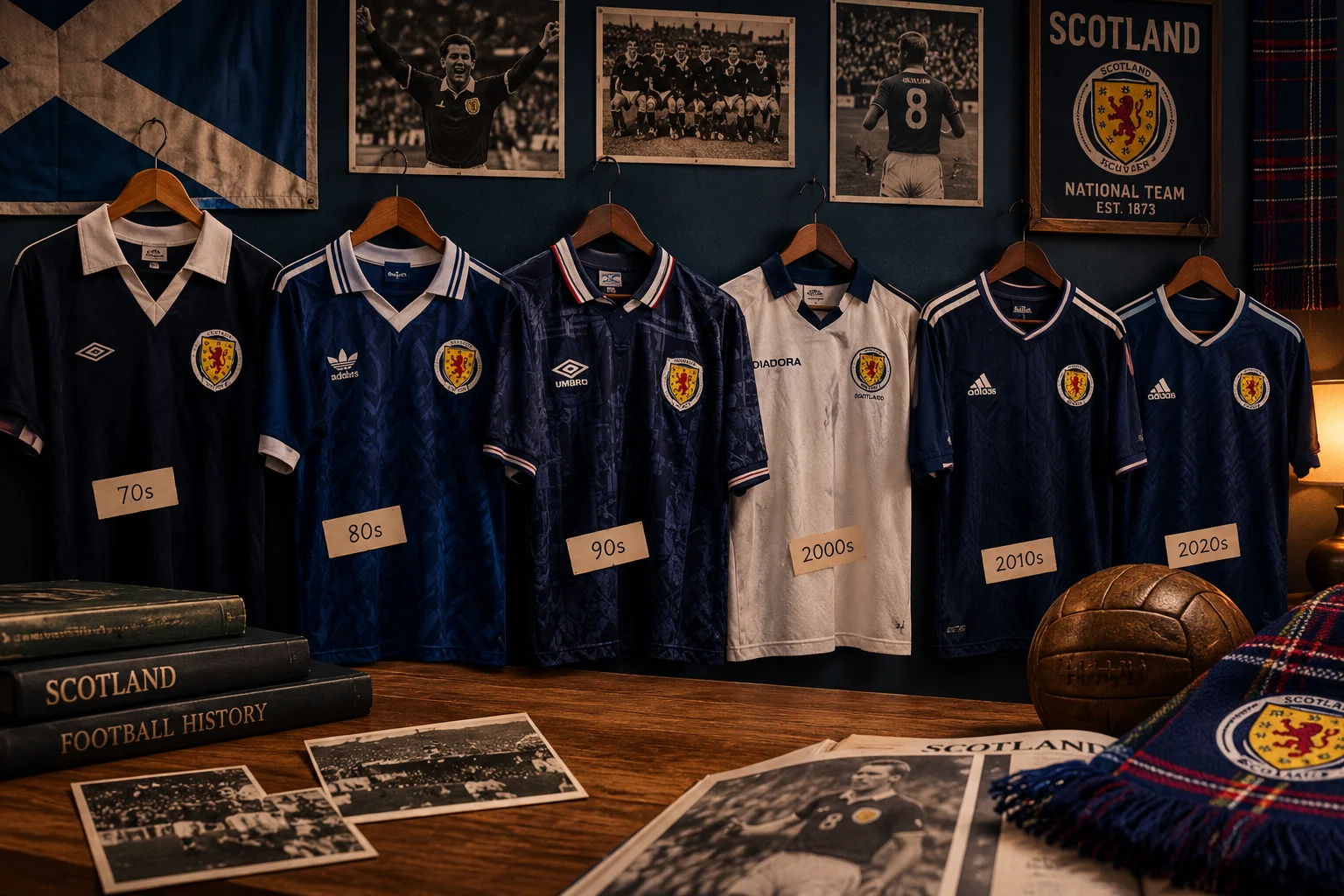
Scotland have not reached many tournaments, but they have produced a remarkable number of memorable shirts. For a national team that has spent long stretches watching major finals from home, the kit has done a lot of the emotional work, and the retro market reflects that. Some of the most collected international shirts anywhere are Scottish.
Knowing which eras matter, and why, is the difference between buying a shirt that holds its appeal and one that sits unworn.
Why do Scotland’s old shirts have such a following?
Because the shirt carried the identity when the results did not.
For supporters who followed the team through the lean years, the shirt was the constant. It was what you wore to watch a qualifying campaign that fell short, and it became tied to the hope rather than the achievement. That gives Scotland’s retro shirts an emotional weight that a more successful nation’s kit does not always carry, and it is why certain designs are remembered so fondly.
The tartan and check designs of certain eras also stand out in a way most international shirts never attempted, which makes them instantly recognisable and genuinely distinctive.
Which eras are most collected?
The tournament years first, and the bold-design years close behind.
Shirts tied to the tournaments Scotland did reach are the obvious ones, because they are attached to real occasions. A shirt worn at a World Cup or a European Championship means something concrete, and those are the shirts that hold value most reliably.
After that come the shirts remembered for their design rather than any result. Certain tartan-patterned home shirts and some of the more adventurous away kits are collected purely for how they look, regardless of what happened in them. Anyone browsing scotland retro shirts will notice those two groups dominate the market: the ones tied to tournaments, and the ones that looked like nothing else.
Does the shade of navy help date a shirt?
A little, though less than the pattern or the maker.
Scotland’s navy has been remarkably consistent compared with most clubs’ colours, which makes it a weaker dating tool than, say, the shifting reds of some English clubs. Small variations exist between manufacturers and eras, but they are subtle, and a collector relies on the tartan, the crest and the maker’s logo far more than on the exact shade of the navy itself.
What should you check on an older Scotland shirt?
The navy first, then the pattern, then the construction.
On a dark shirt, thin fabric and panel variation hide better than on white, so the checks shift. Look at how the crest is attached: an embroidered or woven lion rampant survives decades, a heat pressed one lifts at the corners. Then look at the tartan or check, where one exists, for consistency across the panels, since a pattern that does not match at the seams was cheaply made.
Finally the construction, which separates an original from a reproduction. Fabric weight, label style and stitching method all differ between eras, and a shirt claiming to be from the 1980s or 1990s should feel heavier than a modern one.
Original or reproduction?
Depends entirely on what you want it for.
For wearing, a reproduction of a famous design is the sensible choice. It uses modern fabric, survives washing, and costs far less than an original in good condition. The emotional value of the design is there whether the shirt is thirty years old or thirty days old.
For collecting, an original matters, and the checks above become essential. Scotland’s retro market is smaller than that of the big English clubs, which cuts both ways: originals are scarcer, but demand is lower, so prices are less inflated than for an equivalent club shirt.
Which sponsors and makers help place a shirt?
The kit manufacturer most of all, since there is no shirt sponsor on an international kit to help.
Scotland’s kit supplier has changed a handful of times, and the maker’s logo narrows a shirt to a block of years immediately. Within that block, the collar and the tartan pattern separate the seasons. For a collector, learning the sequence of manufacturers is the single most useful piece of knowledge, because it turns a vague guess into a narrow range before any other detail is considered.
The crest helps too. The lion rampant has been rendered in several styles, and the version on a shirt points to an era.
How do you date a Scotland shirt?
The tartan cycles are the easiest to place, because the pattern was different each time it appeared and absent entirely in the plain-navy years.
Between the patterned cycles, the manufacturer’s logo does most of the work, since there is no sponsor on an international shirt to help. The lion rampant crest has been rendered in several distinct styles, which narrows the era, and the collar settles the cycle within a manufacturer’s period. Photographs from the relevant campaign are the final check.
How do you keep an older shirt in good condition?
Carefully, since older fabric is less forgiving than modern kit.
Wash cool at thirty degrees, inside out, on a gentle cycle, and never use a tumble dryer, which damages old printing and can shrink older polyester. Skip fabric softener, which dulls colours and coats the fibres. Air dry flat rather than on a hanger, because the weight of a wet shirt can stretch old seams. For an original rather than a reproduction, those rules matter more, since the shirt cannot easily be replaced.
Store older shirts folded or flat rather than on wire hangers, which distort the shoulders over time. Collectors who care about condition keep shirts out of direct sunlight, which fades even navy over years.
What about the away shirts?
Often the most interesting of all, and worth a collector’s attention.
Scotland’s away shirts have used yellow, white, salmon pink and various patterned treatments, and because they were not bound by the navy they carried the boldest ideas. Several are more sought after than the home shirts of the same era, purely on design. For anyone starting a collection, the away shirts are where the surprises are.
Our guide to buying a Scotland shirt covers the current kit and sizing, and the same checks on navy and trim apply to the older shirts too.
A short summary for anyone starting out. Buy the tournament shirts and the bold tartan designs for value that holds, check the crest and trim before paying, keep reproductions for wearing and originals for collecting, and look after older fabric carefully. The Scotland shirt rewards a collector more than most international kits, precisely because the team gave its supporters so few tournaments and so many good shirts.
Frequently asked questions
Why are Scotland retro shirts so popular?
Because the shirt carried the team’s identity through long spells without tournaments, giving it emotional weight, and because the tartan and check designs of certain eras are genuinely distinctive.
How do I tell an original Scotland shirt from a reproduction?
By construction: fabric weight, label style and stitching method differ between eras in ways reproductions rarely copy exactly. Originals from the 1980s and 1990s feel heavier than modern shirts.
Which Scotland retro shirts are most collected?
Those tied to the tournaments Scotland reached, and the bold tartan home shirts and adventurous away kits collected for their design.