
 By Callum Fraser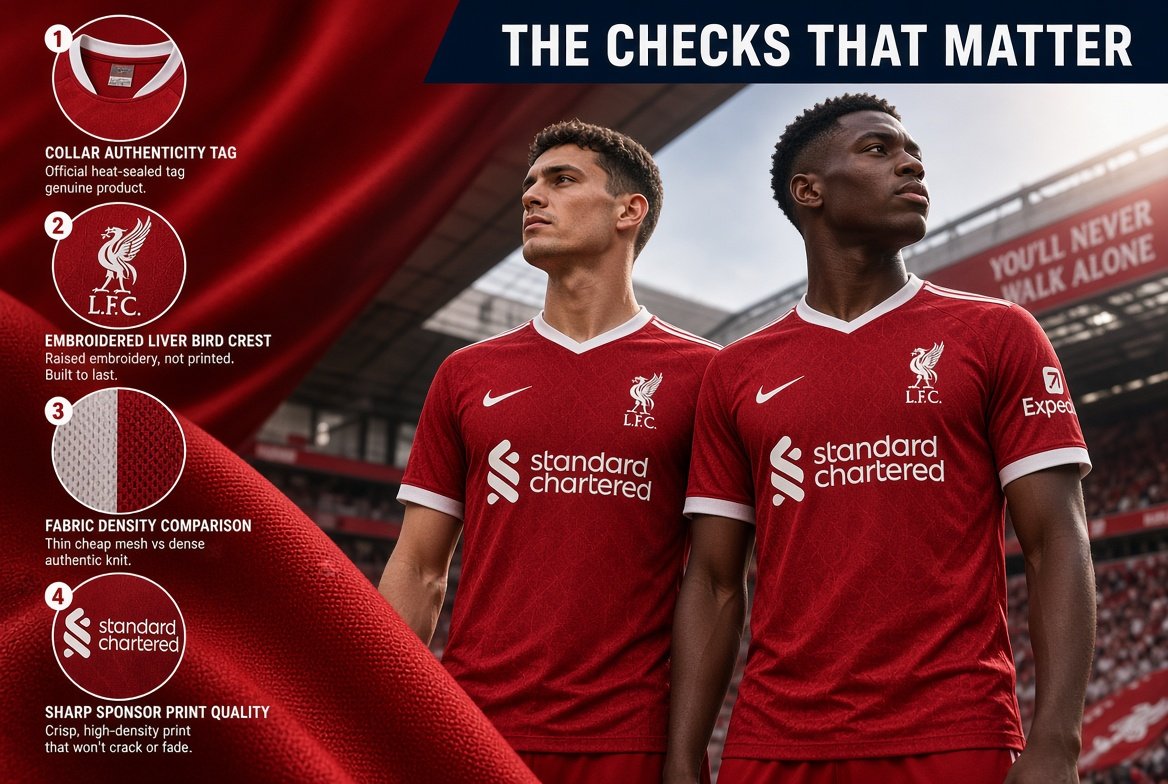
An all-red kit looks like the simplest thing in football to reproduce. One colour, no pattern, no contrasting sleeves. In practice a single solid colour across an entire kit is unforgiving in its own way, because there is nothing to distract the eye from an inconsistency.
If you are buying at the cheaper end, that works in your favour. The faults are visible before you pay.
Why does a single colour kit expose poor production?
Because every panel has to match every other panel exactly.
A shirt is made from several pieces of fabric joined together. If those pieces come from different dye batches, or if the dyeing was inconsistent within a batch, the difference shows at the seam. On a patterned shirt this can hide. On a solid red one it cannot.
The same applies across the kit as a whole. Shirt, shorts and socks are frequently made from different fabrics with different dye characteristics, and getting them to match is genuinely difficult. A kit where the shorts are visibly a different red from the shirt is not rare at the cheaper end of the market.
What should you look at in the photos?
Panel matching first. Find where the sleeve joins the shoulder and check the two reds are identical. Do the same at the side seams and around the collar. Anyone comparing cheap liverpool kits should make this the opening check, because it correlates strongly with the care taken everywhere else.
Then the crest. Embroidered or properly bonded crests last years. Heat pressed badges lift at the corners within months, and on a solid colour background the backing edge of a heat pressed badge is more visible than it would be on a busier shirt.
Then stitching at the hem and cuffs, and fabric texture in close up. A well made shirt shows structure and variation, often with a more open knit across the back. A uniformly flat surface usually indicates the cheapest available base cloth.
Has the red actually changed over the years?
Yes, and it is worth knowing when buying anything that is not current season.
The shade has shifted across the decades as manufacturers and dye formulations have changed. Shirts from different eras do not match each other, which is entirely normal rather than a fault. What is not normal is variation within a single shirt.
So judge an older shirt against photographs from its own season rather than against the current kit. A shirt in a shade that is clearly of its era reads as authentic. A shirt in a shade close to current but not quite matching reads as a poor copy.
Which seasons are worth looking for?
The usual markers apply. An unusual or short lived sponsor pins a shirt to a narrow window and makes it easy to place. A distinctive collar treatment gives the eye something to hold. And a season people remember for other reasons lends the shirt significance the garment did not earn on its own.
Against that, a shirt from a long sponsorship run with a conventional collar is difficult to date and correspondingly less sought after. It is also usually the cheapest option available, which may be exactly what you are after.
Does the kit change much between seasons?
Less than the marketing implies, which is useful to know when deciding whether to buy current or wait.
On an all-red kit there is no pattern to alter and no second colour to rebalance. What changes between seasons is the collar treatment, the trim detailing, the shade of the red itself and whatever texture has been worked into the fabric. That is the whole of it most years.
The practical consequence is that a Liverpool shirt dates slowly in appearance. Two or three seasons on it still looks entirely current to anyone not examining the collar, which strengthens the case for buying last season’s rather than paying the premium for the newest.
Shirt only or full kit?
The shirt is what most people want and it is the sensible default.
A full kit introduces the matching problem described above and adds shorts, which are sized on the waist rather than the chest. A kit sold in a single size assumes both your measurements fall in the same place on the chart, and for plenty of people they do not.
If you want the full kit, buy the pieces separately and accept paying slightly more. The fit will be better and you avoid the situation where the shorts are right and the shirt is not.
How do you get the sizing right?
Measure a shirt you already own and like the fit of. Lay it flat, measure straight across from one armpit seam to the other, and match that half chest figure to the seller’s chart.
Do not rely on the size letter. Football shirt sizing runs differently from high street sizing and varies between manufacturers, so the letter alone means very little. If you are buying a player version rather than a replica, size up, because they are cut noticeably closer and use separate charts.
Does ordering from Scotland change the calculation?
On delivery, yes. Mainland Scotland is generally treated the same as the rest of the UK, but the Highlands, the Islands and some northern postcodes are frequently excluded from free delivery or carry surcharges and longer lead times.
That information usually sits in the delivery terms rather than on the product page, so it is worth finding before you order rather than discovering at checkout. Return postage is the other consideration, since it is frequently the buyer’s cost and distance makes it more significant.
The checks, in order
Panel matching across seams. Crest attachment. Stitching at hem and cuffs. Fabric texture. Then measurements against the chart, then the delivery terms.
Six things, none of which takes longer than a minute, and together they eliminate most of what goes wrong with a cheap kit purchase.
The delivery side deserves its own treatment, and our guide to buying football jerseys from Scotland covers it properly. For the Scottish players who wore this shirt, Scots who wore the Liverpool jersey has the history.
Frequently asked questions
Why do the shorts not match the shirt on cheap kits?
Shirts and shorts are often made from different fabrics with different dye characteristics, and matching them exactly is genuinely difficult. At the cheaper end of the market it is frequently not attempted.
Has Liverpool’s red changed over time?
Yes, across decades, as manufacturers and dye formulations changed. Shirts from different eras do not match each other, which is normal. Variation within a single shirt is not.
How often does the Liverpool kit actually change?
Annually, but the changes are small. With no pattern and no second colour, variation between seasons is limited to the collar, trim, shade of red and fabric texture, so a shirt dates slowly in appearance even as it ages in status.
Should I buy a full kit or just the shirt?
The shirt, for most people. Full kits introduce colour matching between components and add shorts, which are sized on the waist rather than the chest and frequently do not correspond to your shirt size.
[…] modern identity owes more to Shankly than to anyone, and our guide to what to check on cheap Liverpool kits looks at the shirt that grew out of it. For the oldest rivalry of all between the two football […]
[…] present a different set of checks again, and our guide to what to look for on cheap Liverpool kits covers them. For the wider story of Scottish involvement in the English game, the rise of Scottish […]