 By Callum Fraser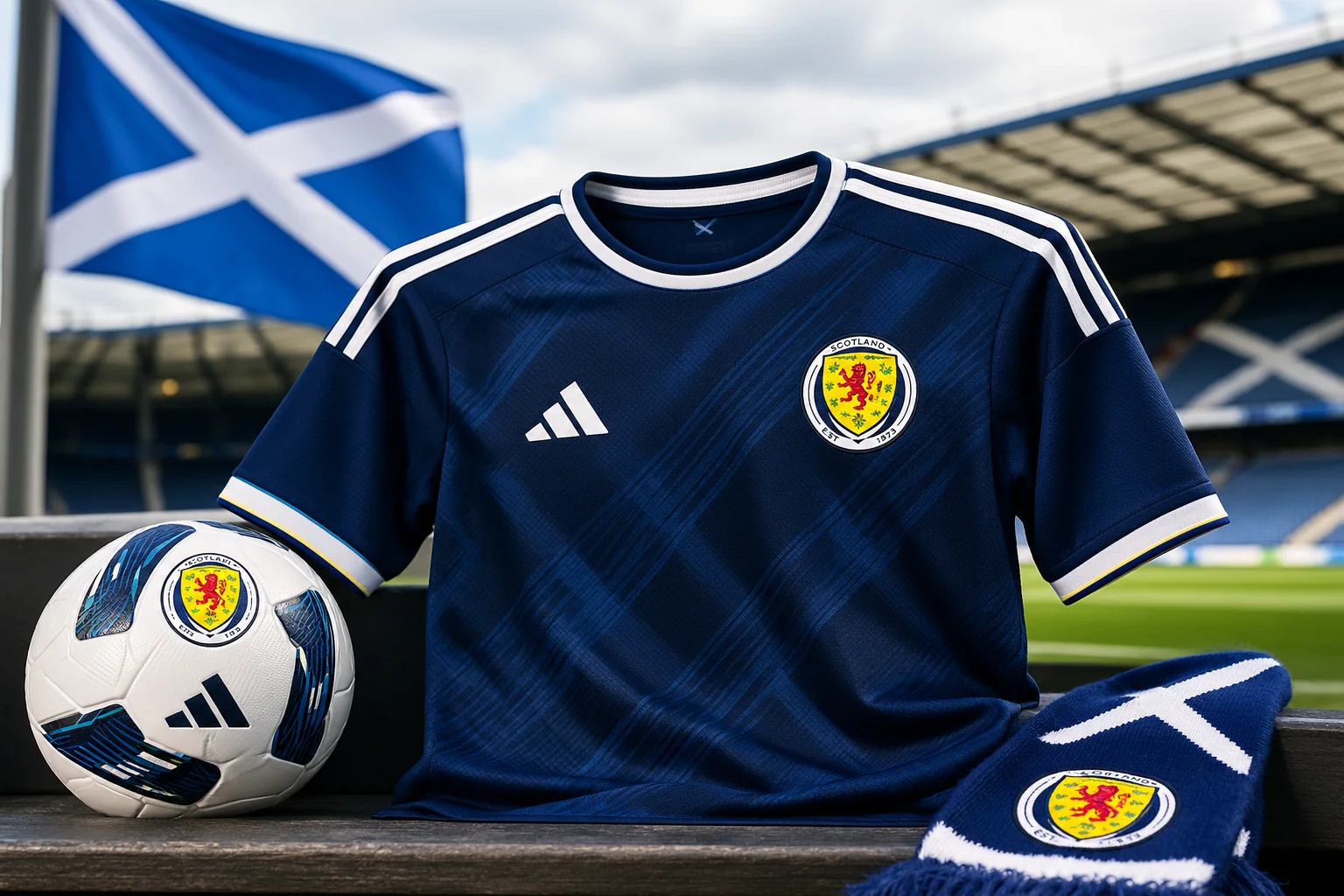
The Scotland shirt has had a difficult relationship with its own supporters for years, mostly because the team gave people so few tournaments to wear it at. That has changed recently, and with it the market for the shirt has grown considerably.
It is also one of the more interesting international shirts to buy, because the design has swung between plain navy and some of the boldest patterns ever put on a national team kit. Knowing what you are looking at matters.
What defines the Scotland home shirt?
Navy, and very little else is fixed.
Scotland have worn dark blue at home since the earliest days of international football, and the shade has stayed remarkably consistent compared with most clubs’ colours. Where the design has varied is in everything around the navy: white or yellow trim, collar styles that have changed with every era, and at several points a tartan or check pattern worked into the fabric.
That tartan is the thing to look for when identifying a shirt. Some cycles used it heavily, others not at all, and the presence, absence and style of the pattern places a shirt quickly.
How does the release cycle work?
Around tournaments, like every international kit, with one complication.
A national team shirt typically runs for about two years, released ahead of a major tournament and replaced ahead of the next. For Scotland, the long gaps between qualifying for tournaments meant that some shirts ran for longer than usual, since there was less pressure to release a new one. That makes certain older shirts more common than the two-year rule would suggest.
For a buyer, the practical point is the same as for any international shirt: the cheapest moment is after a tournament, and a shirt bought early in a cycle stays current for a long time.
Which Scotland shirts are worth having?
The away shirts, quite often, and this is the part most buyers miss.
Scotland’s home shirt is constrained by the navy. The away shirts have been free to experiment, and the results include some of the most distinctive designs in international football, in yellow, white, salmon pink and various patterned treatments. Several are sought after purely on design, regardless of what happened in them.
Among the home shirts, the ones tied to the tournaments Scotland did reach hold their value best. A shirt worn at a finals means something in a way that one worn through a failed qualifying campaign does not, however it looked.
What should you check before buying?
The navy first, because on a dark shirt the faults hide differently from a white one.
Dark fabric conceals thin patches and panel variation better than white, so the checks shift to the crest and the trim. Look at how the badge is attached: embroidered or properly bonded crests survive years, heat pressed ones lift within months. Then look at the boundary between the navy and any white or yellow trim, which should be sharp with no bleed. Yellow against navy is a demanding combination for a dyer and the edge shows carelessness quickly.
Anyone comparing scotland football shirt listings should also check the tartan or pattern, where one exists, for consistency across the panels. Patterns that do not match at the seams are the same production shortcut as misaligned stripes on a club shirt.
Original or reproduction?
For older Scotland shirts the market is smaller than for the big English clubs, which cuts both ways.
Originals from the 1980s and 1990s are scarcer, since fewer were made, but demand is also lower, so prices are less inflated than for equivalent club shirts. Reproductions of the most famous designs exist and are well made, and for wearing rather than collecting they are the sensible choice.
Distinguishing an original from a reproduction comes down to construction: fabric weight, label style and stitching method all differ between eras in ways reproductions rarely copy exactly.
How does sizing work?
The same as any shirt. Measure a shirt you already own and like across the chest, armpit seam to armpit seam, and match that half chest figure to the seller’s chart rather than trusting the size letter.
If you are buying a player version rather than a replica, size up. Player versions are cut closer and use separate charts, and ordering one in your usual replica size is the most common mistake in the market.
Which cycles are easiest to identify?
The tartan ones, without question.
Cycles that used a tartan or check pattern place themselves immediately, because the pattern was different each time it appeared and was absent entirely in the plain-navy years. Between the tartan cycles, the manufacturer’s logo and the collar style do the work, since there is no sponsor on an international shirt to help.
The crest is the other marker. The lion rampant has been rendered in several distinct styles over the decades, and the version on a shirt narrows it to an era before the collar narrows it to a cycle.
Kids’ shirts and the tartan
Children’s Scotland shirts follow the adult designs and the same tournament cycle, sized by height range rather than age. The height figure on the listing is far more reliable than the age label.
One thing worth knowing: the tartan patterns that appear on some cycles are often simplified or removed entirely on the children’s versions, so a kids’ shirt may not match the adult one exactly even in the same season.
When is the best time to buy?
After a tournament, as with any international shirt, and Scotland’s recent qualification record makes this more predictable than it used to be.
Demand for the shirt rises in the months before a finals and falls once the tournament ends, and sellers reduce stock they know will be replaced before the next cycle. The autumn after a summer tournament is reliably the cheapest moment for the current shirt. The most expensive is the spring before one, when everyone wants the same thing at once.
Delivery to Scotland
Worth mentioning even for a Scotland shirt, because most sellers ship from England and the same delivery rules apply as for any club kit. Highland and Island postcodes are frequently excluded from free delivery offers or carry surcharges, and it is usually in the delivery terms rather than on the product page.
Our guide to buying football jerseys from Scotland covers the delivery side in detail.
A short summary, then. Navy is the constant, the tartan is the identifier, the away shirts carry the design interest, and the tournament cycle sets the price. Check the crest attachment and the trim edges before buying, buy after a finals rather than before one, and if you are north of the central belt, read the delivery terms first.
Frequently asked questions
What colour is the Scotland football shirt?
Navy blue at home, with white or yellow trim depending on the era. Away shirts have used yellow, white and various other colours and patterns.
How often does the Scotland shirt change?
Roughly every two years around tournament cycles, though some older shirts ran longer during periods when Scotland did not qualify for finals.
Are Scotland away shirts worth buying?
Often, yes. The away shirts have carried the more adventurous designs, and several are sought after purely for how they look.
[…] guide to buying a Scotland shirt covers the current kit and sizing, and the same checks on navy and trim apply to the older shirts […]