
 By Callum Fraser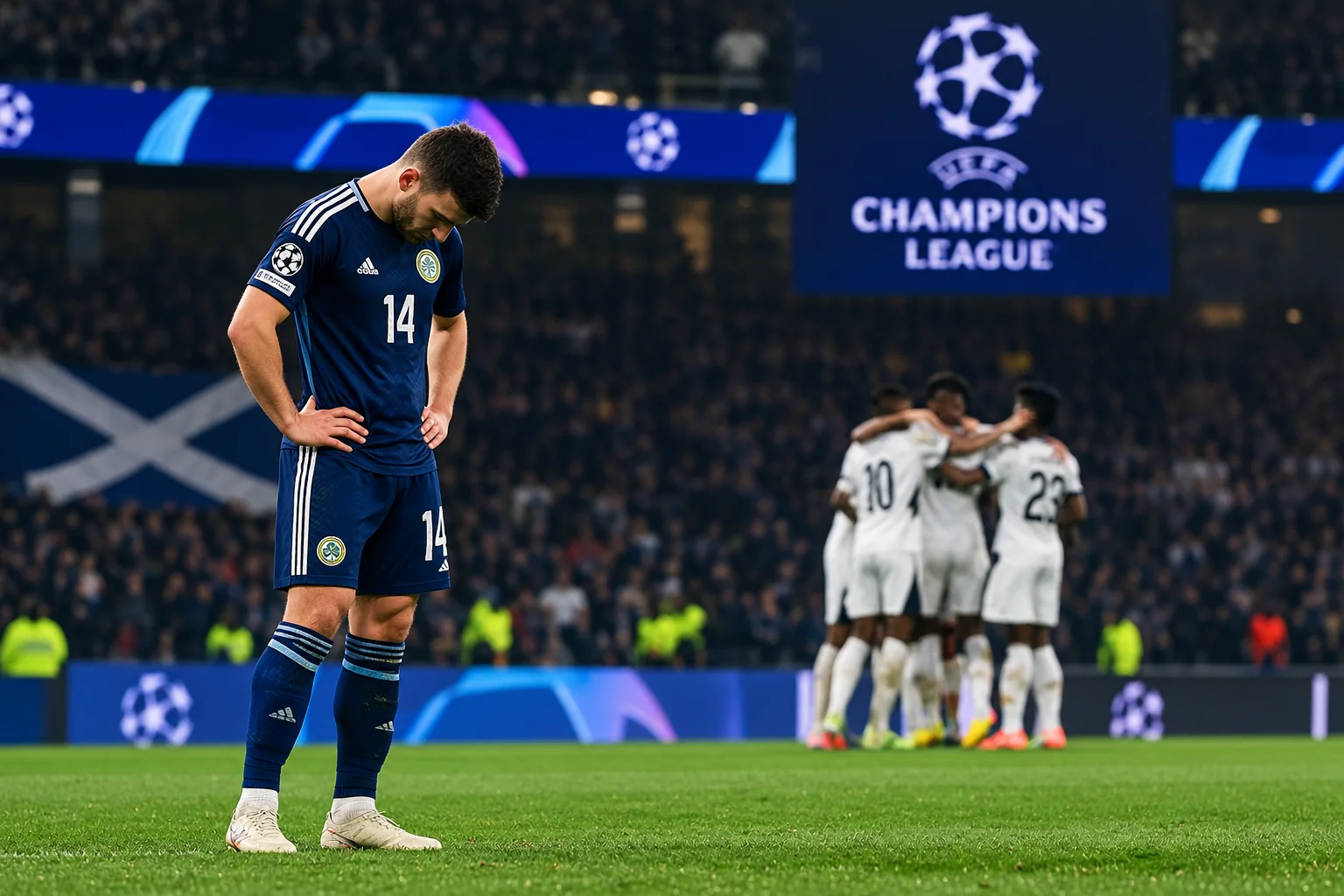
Celtic won the European Cup in 1967 with a team born within thirty miles of Glasgow. Rangers won a European trophy in 1972 and reached a final as recently as 2022. Aberdeen beat Real Madrid to win a European trophy in 1983. Scottish clubs have a real European history, which makes their present difficulties in continental competition harder for supporters to accept.
The reasons the gap has widened are mostly structural, and they are worth setting out honestly.
How big is the gap now?
Large, and it shows most clearly in the group stages of European competition.
Scottish clubs still qualify for European tournaments regularly, and the biggest two usually reach the main stages of one competition or another. But results once there have been poor for a long stretch. Heavy defeats to clubs from the major leagues have become common, and progress beyond the group stage is now an achievement rather than an expectation.
That is a sharp change from the era when Scottish clubs reached finals and won trophies, and it reflects a change in football’s economics more than a change in Scottish football’s quality.
What does money have to do with it?
Almost everything.
European football’s income is dominated by television, and television money is distributed according to the size of each league’s audience. The English, Spanish, German, Italian and French leagues generate vastly more than the Scottish league, and that difference flows directly into what clubs can pay players.
A Scottish club’s entire wage bill is often smaller than a single player’s salary at a major European club. That is not a criticism of how Scottish clubs are run. It is the arithmetic of a small television market competing against enormous ones.
Does the league structure make it worse?
It does, in two ways.
First, the Scottish league has only twelve teams and two dominant clubs, which means the level of week-to-week competition is lower than in larger leagues. Players at the top Scottish clubs face fewer genuinely difficult domestic matches, which makes the step up to European opposition larger than it would otherwise be.
Second, the same dominance means the best young Scottish players are identified and sold early. A talented player at a Scottish club is bought by an English or European side long before he reaches his peak, so the domestic league rarely gets to keep its best talent long enough to build a side around it.
What happens when a Scottish club does well?
The income arrives, and what happens next decides whether it lasts.
A run to the later stages of a European competition brings television money, gate receipts and prize money that can transform a Scottish club’s finances for a season or two. The clubs that have used those windfalls well have invested in youth facilities and recruitment. Those that have spent them on wages for players who then left have found themselves back where they started within a few years.
What about the playing style?
It has changed, though more slowly than elsewhere.
Scottish football was slower than the major leagues to adopt the tactical developments of the last two decades, particularly the pressing and possession-based styles that now dominate at the top level. That gap has narrowed as coaches with continental experience have arrived, and the top clubs now play in ways that would be recognisable anywhere in Europe.
But adopting a style is not the same as executing it against better players, and the quality gap remains the fundamental problem.
Was it always like this?
No, and that is what makes the current position sting.
For much of the twentieth century the gap between Scottish clubs and the European elite was far smaller. Television money did not exist in its current form, players moved less freely between countries, and a well-coached side from a small country could genuinely compete. Celtic’s 1967 team and Aberdeen’s 1983 side were not flukes. They were what Scottish football could produce when the playing field was closer to level.
The playing field is no longer level, and it is not going to be levelled by Scottish clubs alone.
Do other small countries face the same problem?
Yes, and comparing them is instructive.
Clubs from the Netherlands, Portugal, Belgium and Scandinavia face the same television arithmetic and the same loss of talent to the major leagues. Some have handled it better than Scotland, mostly through youth development and shrewd recruitment that turns young players into transfer income before they leave. The Dutch and Portuguese models, in particular, show that a small league can remain competitive in Europe if it accepts its role as a developer of players rather than a destination for them.
Scotland has started down that path, but later than others.
Can anything change it?
Marginally, and mostly through what Scottish clubs can control.
Better youth development keeps more value in the country for longer. Smarter recruitment finds players other leagues have overlooked. Careful management of the money that European qualification brings can compound over several seasons. And a run in a European competition, when it happens, brings both income and belief.
Structural reform of European football’s finances is the only thing that would close the gap properly, and that is out of Scottish hands. Until it happens, Scottish clubs are competing with a permanent disadvantage and doing reasonably well to reach the stages they reach.
Does the coefficient matter?
More than most supporters realise, because it decides how many European places Scotland gets and where its clubs enter the competitions.
European competition places are allocated according to each country’s results over several seasons. Better results mean more places and later entry, which means fewer qualifying rounds to survive. Worse results mean the opposite. Scotland has moved up and down that ranking, and each move changes how hard the following season’s route into Europe becomes.
That creates a cycle. Good European results improve the ranking, which makes qualification easier, which produces more chances for good results. Poor results do the reverse. Climbing out of a bad spell is genuinely difficult because the system makes it harder as you fall.
What it means for supporters
A more realistic set of expectations, which is not the same as lower ambition.
Reaching the main stages of European competition, winning the occasional group match against a bigger side, and progressing to the knockout rounds now and then are genuine achievements for a Scottish club. Supporters who measure their clubs against 1967 and 1983 will be disappointed. Those who measure them against what is realistically possible will find more to enjoy.
The rivalry at home has never depended on European results, as our piece on the Old Firm derby explains.
None of this is a reason to stop caring about European nights. They remain the occasions when Scottish football measures itself against the rest of the continent, and the rare good results mean more precisely because they are hard to come by.
Those nights are also why the retro football shirts from the great European campaigns still sell to people who were not born when they were worn.
Frequently asked questions
Have Scottish clubs won European trophies?
Yes. Celtic won the European Cup in 1967, Rangers won the Cup Winners’ Cup in 1972 and Aberdeen won it in 1983.
Why do Scottish clubs struggle in Europe?
Mainly money. Television income in Scotland is a small fraction of that in the major leagues, which limits what clubs can pay players. The small, two-club-dominated league adds to the gap.
Can Scottish clubs compete in Europe again?
At the highest level, only with structural change to European football’s finances. Within the current system, good youth development and recruitment can produce occasional strong campaigns.
[…] piece on why Scottish clubs struggle in Europe covers what happens to those players once the bigger leagues come […]