 By Callum Fraser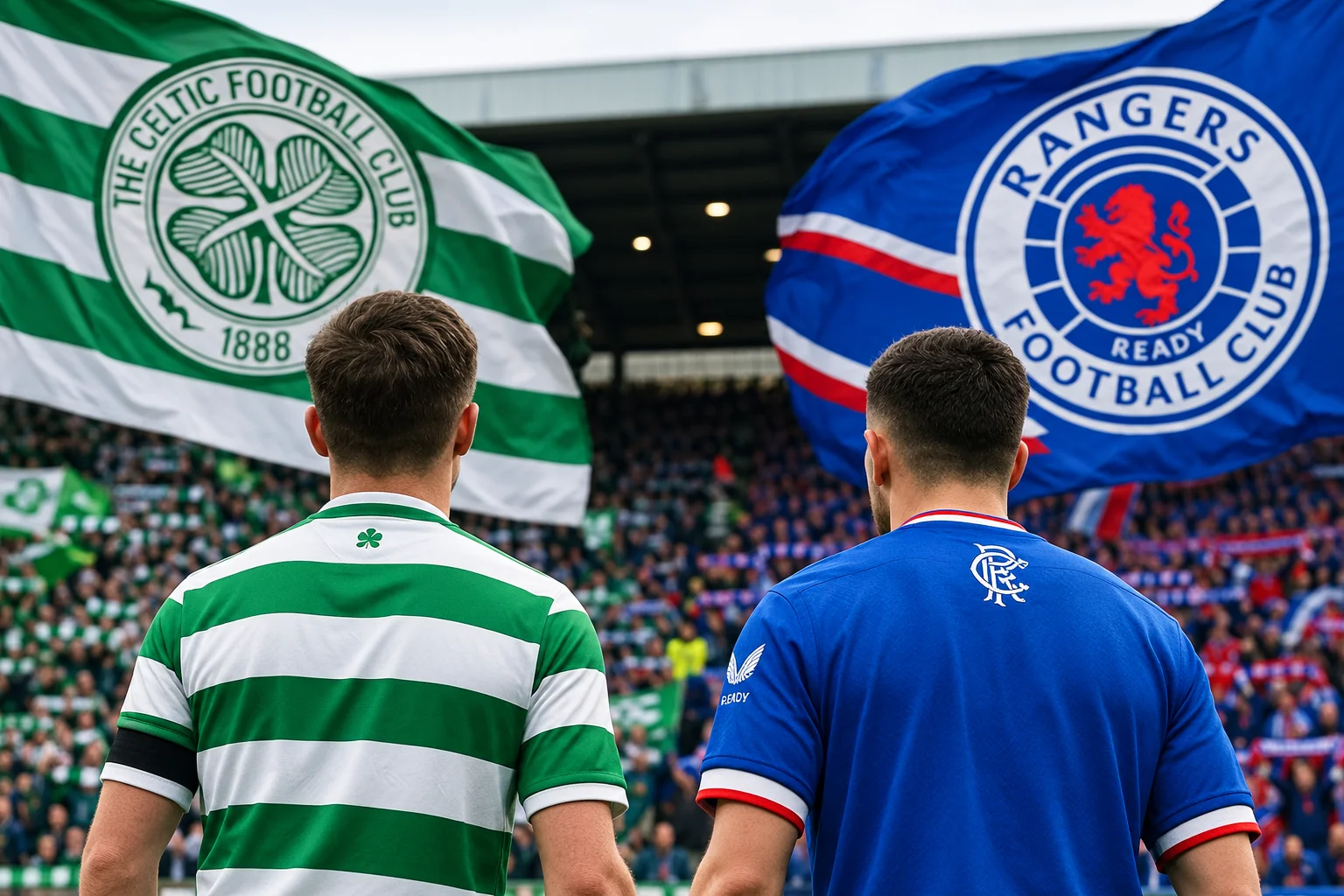
Most football rivalries are about football. The Old Firm derby between Celtic and Rangers is about football and a great deal else besides, which is why it has a reputation that reaches far beyond Scotland and why people who have never seen it played know its name.
Understanding it means understanding a bit of Glasgow’s history, because the rivalry grew out of the city as much as out of the game.
Where did the two clubs come from?
From different parts of the same city, founded within a few years of each other in the late nineteenth century.
Rangers were founded first, in 1872, by a group of young men who wanted to play football. Celtic followed in 1887, established by a Catholic priest to raise money for the poor of the East End of Glasgow, much of it an Irish immigrant community. From the beginning the two clubs drew support from different populations, and the divide between them followed lines that already existed in the city.
That is the origin of everything that came after. The rivalry did not create the divisions. It gave them a fixture.
Why is it called the Old Firm?
The name reflects the fact that the two clubs, whatever their differences, have always shared an interest in their rivalry.
The phrase appeared in the early twentieth century and referred to the way the two clubs behaved like partners in a business, both benefiting from the enormous crowds and attention the fixture generated. Between them they have dominated Scottish football almost completely, winning the large majority of league titles since the league began.
That shared dominance is itself part of the rivalry. For most of its history, beating the other has been the only thing that mattered, because nobody else was likely to.
What makes it different from other derbies?
The layers underneath it, and the fact that for a long time they were not spoken about openly.
Where most derbies divide a city by geography, the Old Firm historically divided it by religion, by heritage and by politics. The two sets of supporters carried identities that extended far beyond the club, and the match became a place where those identities were expressed. That gave the fixture an intensity that other rivalries rarely reach, and a capacity for trouble that has troubled the authorities for over a century.
Both clubs and the wider game have worked hard to reduce the sectarian element, with some success. But the history remains, and it is why an Old Firm match feels charged in a way that a match between two clubs who simply dislike each other does not.
How do the two clubs share the city?
Uneasily, and more closely than outsiders expect.
Glasgow does not divide neatly into a Celtic half and a Rangers half. Supporters of both clubs live on the same streets, work in the same places and sit in the same pubs on non-match days. Families are split, workplaces are mixed, and the rivalry is lived at close quarters rather than across a boundary. That closeness is part of what keeps it sharp.
The grounds themselves sit on opposite sides of the city, Celtic Park in the East End and Ibrox in the South Side, and a supporter’s journey to an away Old Firm match crosses the whole of Glasgow to reach the other’s territory.
What is the match itself like?
Loud, fast and often bad-tempered.
Old Firm matches are played at a pace that surprises visitors, with tackles flying in and referees under pressure from the first minute. The atmosphere at both grounds is among the most intense in Britain, with each club’s supporters producing noise that rarely drops throughout the match. Away fans are given a small allocation, which concentrates the sound further.
Results matter enormously. A win over the other half of the city can define a season, and a run of defeats to them can end a manager’s time at the club regardless of what else has happened.
What are the famous matches?
Too many to list, and every supporter has their own.
Cup finals between the two carry the most weight, since they combine the rivalry with a trophy. League matches that decided titles are remembered for decades. And then there are the matches remembered for the wrong reasons, for the trouble on the pitch or the terraces, which are part of the history whether either club likes it or not.
The Scottish Cup final of 1980 is remembered for the riot that followed it as much as the football, and it led to a ban on alcohol at Scottish grounds that lasted for years. That is the kind of consequence the fixture has produced.
How has the rivalry changed?
In several ways, some of them significant.
Rangers’ financial collapse and demotion to the lowest tier of Scottish football in 2012 meant the fixture was not played in the league for several seasons, which some supporters felt weakened the rivalry and others felt intensified it. Both clubs have also become far more international in their playing staffs, which has changed the character of the teams even as the supporters’ identities have stayed the same.
Efforts to remove sectarianism from the fixture have changed the atmosphere too, and the match is safer than it was for much of the twentieth century.
What is it like to attend?
Intense from the moment you leave the station, and not something to approach casually.
Both grounds are large and both are full for the fixture, with the atmosphere building through the streets around them well before kick-off. Away supporters travel in a small block and are kept separate throughout. The noise inside is sustained in a way that few fixtures anywhere match, and the match itself is usually played at a pace that reflects it.
For a neutral it is one of the great experiences in British football. For a supporter of either club it is something closer to an ordeal, however the match ends.
Why does it still matter?
Because the two clubs remain the dominant forces in Scottish football, and because the identities that underpin the rivalry have not gone away.
For many supporters on both sides, the Old Firm match is the most important fixture of the year, more important than European ties or cup finals. It remains one of the few derbies where the result genuinely alters how a season is judged.
Our piece on why Scottish managers thrived in English football looks at what Scottish football exported. The Old Firm is the part that stayed home.
It is, in the end, a rivalry about identity as much as football, which is why it has outlasted every attempt to explain it away and why it will still be the fixture Glasgow stops for long after the current players have gone.
Both halves of the city sell their colours in huge numbers, and the demand for Celtic hoops and Rangers shirts says as much about the rivalry as anything on the pitch.
Frequently asked questions
Who are the Old Firm?
Celtic and Rangers, the two largest clubs in Glasgow and in Scotland, whose rivalry dates from the late nineteenth century.
Why is it called the Old Firm?
The name arose in the early twentieth century from the idea that the two clubs, despite their rivalry, behaved like business partners who both profited from the fixture.
Why is the Old Firm derby so intense?
Because it historically divided Glasgow along lines of religion, heritage and politics as well as football, giving the match layers of meaning that most derbies do not carry.
[…] rivalry at home has never depended on European results, as our piece on the Old Firm derby […]
[…] simply about football, which is why it has outlasted every attempt to explain it in football terms. The Old Firm derby explained covers where the two clubs came from, what the fixture is actually like, and why it still stops […]