 By Callum Fraser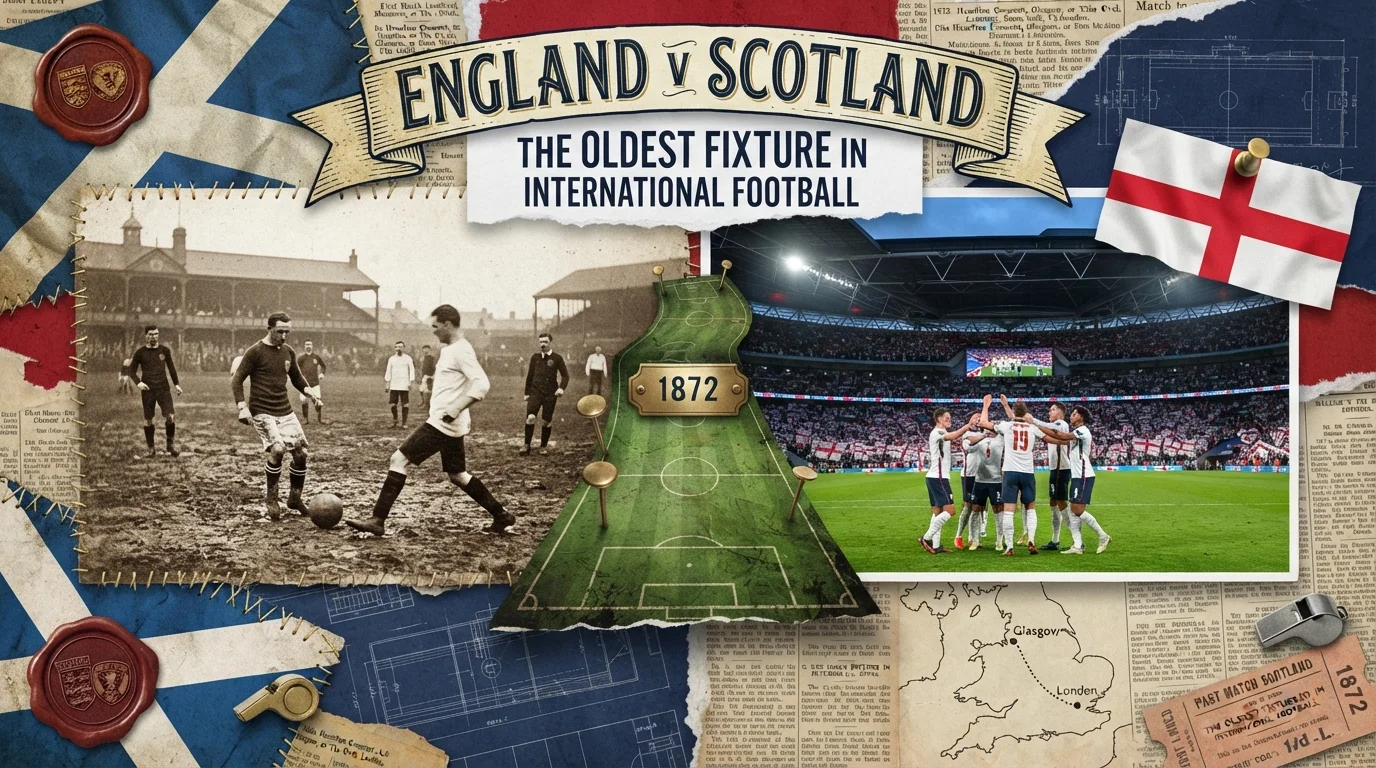
Every international football match played today traces its line back to one afternoon in Glasgow in 1872. Scotland and England met at a cricket ground in Partick, drew nil-nil in front of a few thousand spectators, and created a fixture that would carry more weight than any other in British football for more than a century.
The rivalry has been quieter in recent decades, simply because the two sides meet far less often. But its history is richer than almost any other fixture in the game.
How did the first international happen?
The match on 30 November 1872 at Hamilton Crescent is recognised as the first official international football match in the world.
There had been earlier games between English and Scottish sides in London, but those Scottish teams were largely made up of Scots living in England. The 1872 match was different. It was played in Scotland, with a Scottish side drawn from Scottish football, against a team chosen by the Football Association.
The result was a draw with no goals, which sounds unremarkable. What mattered was that it happened at all. It established the idea of countries playing each other at football, and everything that came afterwards, from the World Cup to the European Championship, grew from that principle.
Why did the two sides play differently?
The early matches were a clash of styles as well as nations, and that clash shaped the game.
English football at the time relied heavily on dribbling, with players running at defenders with the ball and teammates following behind in support. Scottish sides developed a passing game, moving the ball between players instead of carrying it. Against a dribbling team, passing could be devastatingly effective.
That Scottish passing approach spread as Scottish players moved south to play in England, and over time it became the foundation of how football was played everywhere. In a real sense, the rivalry helped invent the modern passing game.
How often did they play each other?
For a very long time, almost every year.
From the 1880s the fixture formed part of the British Home Championship, an annual tournament between England, Scotland, Wales and Ireland. England against Scotland was the match that mattered most in it, and for many supporters it was more important than any other game in the calendar.
The Home Championship ended in the 1980s, and the fixture effectively lost its regular place soon afterwards. Since then the two sides have met only occasionally, in tournaments or qualifying groups, which has turned what was once routine into something rare.
Which meetings are remembered most?
A few stand out above the rest, and Scottish supporters in particular have long memories.
In 1967 Scotland beat England three-two at Wembley. England were the reigning world champions, having won the World Cup the previous summer, and Scottish fans have joked ever since that the win made Scotland the unofficial champions of the world.
Wembley in 1977 is remembered for what happened after a Scotland win, when supporters poured onto the pitch and broke the crossbar. And at Euro 96, England won two-nil at Wembley, with Paul Gascoigne scoring one of the most replayed goals in English football history.
Each of these carries a meaning that goes beyond the scoreline, because the rivalry was always about more than one afternoon.
Who had the better of the early matches?
Scotland, for much of the early period, which surprises people who assume the larger country always dominated.
The Scottish passing game gave Scotland a real edge in the first decades of the fixture, and Scottish sides won a good share of the early meetings. It took time for English football to adopt and then master the passing style, and the balance of results shifted as it did. Those early Scottish successes laid the foundation for the fierce pride that the fixture carried in Scotland for generations afterwards.
Did the rivalry shape the rules of the game?
In a quiet but lasting way.
The football associations of England, Scotland, Wales and Ireland came together in 1886 to form the International Football Association Board, the body that still writes the Laws of the Game today. The need for common rules had grown out of matches between the home nations, where differences in how each country played the game caused regular disputes.
That means the four British associations have had a hand in shaping football’s laws ever since, a direct legacy of the international matches that began with England and Scotland in 1872.
Why did the rivalry matter so much?
Because it was never really only about football.
For Scotland, beating England carried a weight that no other result could match. England was the larger, richer and more powerful neighbour, and a win over them was a chance to prove something that stretched well beyond sport. That gave the fixture an emotional intensity in Scotland that was not always matched on the English side, where many fans saw other rivals as equally important.
That imbalance is part of what made it so fascinating. The two sets of supporters did not always feel the same way about the match, and the difference revealed a great deal about both countries.
What was the trip to Wembley like?
For generations of Scottish supporters, the journey to Wembley every other year was an institution in itself.
Tens of thousands travelled south, turning the trip into a weekend-long gathering that took over central London. For many it was the high point of the football year, whatever the result. Those trips created their own folklore, much of which is still retold by people who made them.
When the regular fixture ended, that tradition went with it, which is one reason older supporters speak about the rivalry with such fondness.
Does the rivalry still exist today?
It does, though it lives more in memory and in occasional meetings than in regular competition.
When the two sides are drawn together now, the build-up is enormous, precisely because it happens so rarely. The old rivalry wakes up quickly. And the fixture still holds its place in history as the one where international football began. The Scottish FA marks the 1872 match as a founding moment for the national team, and it remains one of the proudest facts in Scottish football.
For the shirt that England wear in these meetings, our buyer’s guide to the England football shirt covers what to check before buying one. For the Scots who made their names managing in England instead, our piece on why Scottish managers thrived in English football tells that story.
Frequently asked questions
When was the first England v Scotland match?
On 30 November 1872 at Hamilton Crescent in Partick, Glasgow. It finished nil-nil and is recognised as the first official international football match.
What was the British Home Championship?
An annual tournament between England, Scotland, Wales and Ireland that ran from the 1880s until the 1980s. England against Scotland was usually its most important fixture.
Why is the 1967 match famous?
Scotland beat England three-two at Wembley while England were the reigning world champions, leading Scottish fans to claim the unofficial title of world champions.
[…] piece on England versus Scotland, the oldest fixture in international football covers the matches that first gave Scottish supporters a reason to […]
[…] that grew out of it. For the oldest rivalry of all between the two football nations, our piece on England v Scotland, the oldest fixture in international football tells the […]