
 By Callum Fraser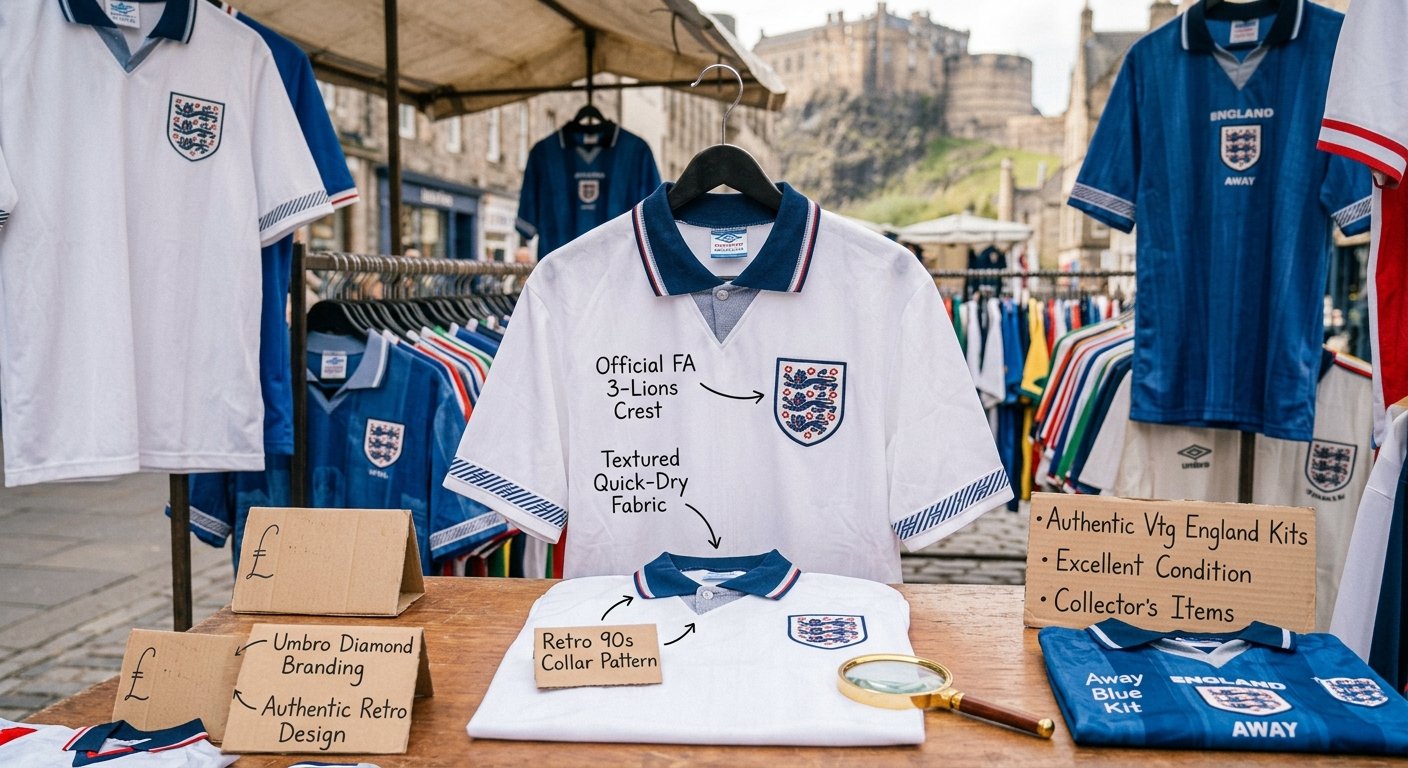
There is an obvious joke available on a Scottish football site about buying an England shirt, and it has been made often enough. Set it aside for a moment, because as a garment it is one of the more interesting things in the market and the buying considerations are genuinely distinct.
White home kits are the hardest to produce well, international shirts follow a different release cycle from club kits, and the retro market for older England shirts is unusually active. All three affect what you should be looking at.
Why is a white kit harder to buy well?
Because white conceals nothing.
Uneven dye uptake, variation in fabric weight between panels, thin patches in the knit and any inconsistency in finish are all visible on white in a way they simply are not on a coloured shirt. Every production shortcut shows.
White also ages fastest. Poor quality white polyester develops a grey cast through repeated washing and does not recover from it. A well made white shirt stays white for years. A badly made one looks tired within a season, which is a shorter life than most people expect from a shirt they wore twice.
For anyone assessing an england football shirt at the cheaper end, that visibility is useful rather than a problem. The faults are in the photograph.
What should you check in the product photos?
Panel consistency first. Find where the sleeve meets the shoulder and check the two whites match exactly. Do the same at the collar and any side panels. A tonal difference between panels means mixed fabric or inconsistent dyeing.
Opacity second. A white shirt photographed on a mannequin should not show the form underneath through the fabric at the shoulders or chest. Visible shadow means the knit is too light, and it will look thinner in person than in the image.
Crest attachment third. Against white, a heat pressed badge shows a faint rectangular outline where the backing film ends, and it is visible in normal light. Embroidered crests do not have that problem. This is the easiest photograph for a seller to take, so its absence is worth noticing.
Does the red trim cause problems?
It is where poor dye stability reveals itself, in the same way navy does on other white kits.
Red against white is a demanding combination, and red is among the least stable dyes. Look closely at the boundary between any red trim and the white body. It should be sharp. Softness or a pink halo at that edge means the dye will keep transferring in the wash, and on a white shirt that is a serious problem rather than a cosmetic one.
How does the international release cycle differ?
Club kits follow an annual summer cycle. International kits do not, which changes the buying calculation.
National team shirts are typically released around major tournaments and often run for two years or more rather than one. That means an international shirt stays current for longer than a club shirt does, and the pressure to replace it is weaker.
It also means the discount pattern is different. Club shirts reduce predictably in spring ahead of the next release. International shirts hold price through a tournament cycle and drop afterwards, so the cheapest moment is usually the year after a tournament rather than at a fixed point in the calendar.
Which England shirts are most sought after?
The same three factors that apply everywhere, with one addition.
A distinctive collar treatment dates a shirt and keeps it recognisable. An unusual manufacturer period does the same. A tournament that people remember lends significance the garment did not earn alone.
The addition is that away shirts have historically been where the more interesting design decisions happened, and several of England’s away kits are considerably more distinctive than the home shirts of the same period. If you want something that stands apart, the away shirts are the stronger hunting ground.
Are retro England shirts a different market?
Substantially, and it is more active than the equivalent market for most club shirts.
International shirts are produced in large numbers around tournaments and then not at all, which creates clear generational blocks rather than the continuous annual run a club produces. That makes older England shirts easier to categorise and easier to collect systematically.
The practical consequence for a buyer is that reproduction is widespread, since the famous designs have a broad market. Distinguishing an original from a reproduction comes down to construction details rather than appearance: fabric weight, stitching method, label construction and how the crest is applied all differ between eras in ways reproductions rarely match exactly.
How should you wash a white shirt?
More carefully than a coloured one, and most of the outcome is in your hands.
Cool at thirty degrees, inside out, which protects the crest and any printing. Wash with other whites rather than in a mixed load, because white polyester takes colour transfer readily and holds it.
Keep it out of the tumble dryer entirely. Heat lifts heat pressed crests, cracks printed numbers and accelerates yellowing in polyester. Skip fabric softener, which dulls the white and coats the fibres.
What about sizing?
Standard method. Measure a shirt you already own across the chest, armpit seam to armpit seam, and match that half chest figure to the chart rather than the size letter.
One consideration specific to white: a close fitting white shirt shows more through the fabric than a dark one. If you are between sizes, the larger is generally the safer choice.
The summary
White shows every fault, which makes it easy to assess before buying. Check panel consistency, opacity and the crest backing edge. Look at the red trim boundary for bleed. Buy the year after a tournament rather than during one. And wash it separately from everything else.
Whatever your feelings about the shirt, it is an object worth judging properly. The white is the hardest home colour in international football to produce well, which means a good one represents real manufacturing care and a poor one is obvious from across a room. That is a more interesting thing to assess than most kits offer. For the comparison most readers here will actually want, England’s kit against Scotland’s puts the two side by side. And for the buying logistics from a Scottish address, our guide to ordering jerseys from Scotland covers the delivery side.
Frequently asked questions
When is the cheapest time to buy an England shirt?
The year after a major tournament. International kits run on tournament cycles rather than the annual club calendar, so prices hold through a tournament and drop once the next cycle approaches.
How do I check a white shirt is thick enough?
Look for shadow showing through the fabric in photographs taken on a mannequin, particularly at the shoulders and chest. Visible form underneath means the knit is too light.
How do I tell an original England shirt from a reproduction?
Construction rather than appearance. Fabric weight, stitching method, label construction and crest application differ between eras in ways reproductions rarely replicate exactly, because doing so would cost more than the market supports.
Do England shirts change every season?
No. International kits typically run for two years or more, often tied to tournament cycles, which is a longer life than the annual replacement cycle club shirts follow.
[…] the shirt that England wear in these meetings, our buyer’s guide to the England football shirt covers what to check before buying one. For the Scots who made their names managing in England […]
[…] England shirt is its own question on a Scottish site, and our buyer’s guide to it takes it on directly. For how these shirts became objects people collect at all, when football […]