
 By Callum Fraser
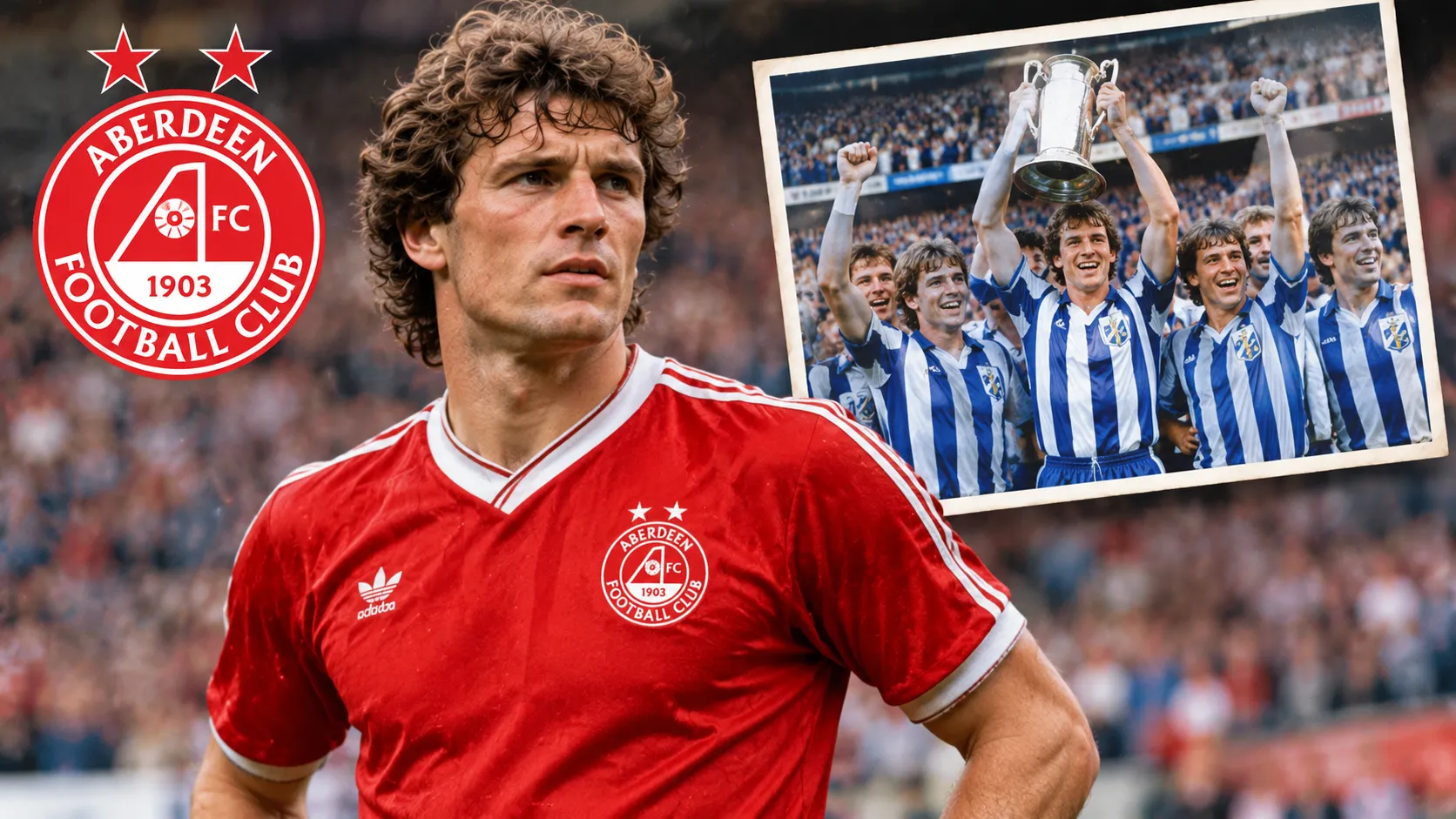
Of all the aberdeen shirts ever produced, one short period accounts for most of the demand. Between 1980 and 1986 Aberdeen won three league titles, four Scottish Cups, a European trophy and a European Super Cup, and they did it with a side built almost entirely in the north east of Scotland under a manager nobody outside the game had heard of.
That run is the reason a red shirt from the early eighties sells for more than one from any other era, and it is also the strongest evidence against the idea that Scottish football has only ever had two clubs.
What actually happened in Gothenburg
In May 1983, Aberdeen beat Real Madrid in the final of the European Cup Winners’ Cup, in Gothenburg, in heavy rain, after extra time. Eric Black scored early, Madrid equalised from the penalty spot, and John Hewitt got the winner in the second period of extra time.
The manager was Alex Ferguson, then in his early forties and five years into the job. The squad was overwhelmingly Scottish and largely local, which is the part that has aged into something close to disbelief a provincial club with a modest budget beating the most decorated side in European football, with players it had found and developed itself.
Later that year the same side beat Hamburg over two legs to win the European Super Cup. For a club of Aberdeen’s size, in a league with Scotland’s resources, it is a result without a modern equivalent anywhere in Europe.
Why do the shirts from that era sell?
Because the demand for a football shirt tracks what the shirt is attached to rather than how good the design was. The early-eighties Aberdeen home shirt is a plain red garment with white trim and little else going on, and it outsells more interesting designs from the club’s history by a wide margin.
There is a scarcity effect on top of it. Aberdeen’s replica production in that period was small by modern standards the replica market was still developing and the club was selling into a city of around two hundred thousand people so originals are genuinely rare rather than notionally rare.
That combination is why reproductions of the period are worth considering if you want the shirt rather than the artefact. The licensed versions are a fraction of the price of an original and the design is simple enough that a good reproduction gets very close.
How do you date an Aberdeen shirt?
The usual four markers, in the usual order. The sponsor narrows it fastest, because Aberdeen’s shirt sponsors have changed on a reasonably regular cycle and each deal covers a defined block of seasons. Then the supplier’s logo, then the crest treatment, then the collar.
The crest is the most useful on Aberdeen specifically, because the club has used noticeably different badge designs across the decades including periods with a simple monogram rather than the full coat of arms and each version sits in a clear window.
Collars help with the older shirts. The pointed and buttoned collars of the seventies and early eighties were replaced by crew and ribbed necks later, and a reproduction claiming to be from the Gothenburg period with a plain modern crew neck has been made to a price rather than to the original.
Pittodrie, and two things it did first
Worth knowing because they come up constantly and are both true. Pittodrie was the first all-seater stadium in Britain, converting in the late seventies more than a decade before the all-seater requirement arrived in English football, and entirely by the club’s own choice.
It is also where the dugout was invented. Aberdeen’s trainer in the nineteen-twenties, Donald Colman, wanted to watch his players’ footwork at pitch level while staying out of the weather, so he had a sunken shelter built. The idea spread across Britain and then across the world, and every dugout in football traces back to a wet afternoon in Aberdeen.
For a club whose European night is the thing everyone remembers, those two details are a decent reminder that the north east has contributed rather more to the game than one final.
The rest of the back catalogue
Narrowing the focus to one era does the club a disservice, and there is more in the archive than the 1983 shirt. The seventies produced some of the better plain red designs, with the pointed collars and simple white trim that have aged far better than most of what followed.
The nineties are the period collectors argue about. Aberdeen’s shirts from that decade carried the busier patterning and bolder trim of the time, and opinion splits sharply between people who find them of their era in a good way and people who find them of their era in the other way. Prices reflect that division they are the cheapest Aberdeen shirts to buy and the hardest to resell.
The away and third kits across all periods are the quiet value. Produced in smaller numbers, discounted harder when current, and frequently more interesting than the home shirt because that is where the design freedom went once red was fixed.
What came after
A long decline, and an honest account has to include it. Aberdeen have not won the league since 1985, and the gap between the Glasgow clubs and everybody else widened through the nineties and has never meaningfully closed.
The reasons are financial rather than footballing, and they apply across the whole league: a small broadcast market, limited commercial reach, and a transfer market in which any player good enough to make a difference is affordable to clubs in England. Our piece on why Scottish clubs struggle in Europe covers the mechanics.
Which is partly why the Gothenburg shirts matter so much to the people who buy them. They are from the last period in which a Scottish club outside Glasgow could reasonably expect to win things, and everyone involved knows it.
Buying one, practically
Decide first whether you want an original or a reproduction, because they are different purchases. An original from the early eighties is a collector’s item, priced on condition, and should be bought from somebody who will photograph the labels and the inside of the neck.
A licensed reproduction is a shirt to wear. Check the crest detail at arm’s length, check the collar matches the era, and buy on chest measurement rather than the size letter retro cuts run wider and shorter than modern ones. The same checks apply across any club’s back catalogue, as our guide to Scotland retro shirts sets out.
And be wary of anything described as both original and reproduction, which is a contradiction and usually a deliberate one. How the club funds itself today is a separate and bleaker story, covered in how Scottish clubs survive on small budgets.
Frequently asked questions
What did Aberdeen win in 1983?
The European Cup Winners’ Cup, beating Real Madrid 2-1 after extra time in Gothenburg, and later the same year the European Super Cup against Hamburg.
Why are early-eighties Aberdeen shirts so sought after?
Because of what they are attached to. That side won three league titles, four Scottish Cups and a European trophy, and replica production at the time was small, so originals are genuinely scarce.
How do I date an Aberdeen shirt?
Sponsor first, then the supplier’s logo, then the crest version, then the collar. Aberdeen’s badge has changed noticeably across the decades, which makes it unusually useful.
Was Pittodrie really the first all-seater stadium in Britain?
Yes, converting in the late nineteen-seventies by the club’s own choice. It is also where the dugout was invented, in the nineteen-twenties.