
 By Callum Fraser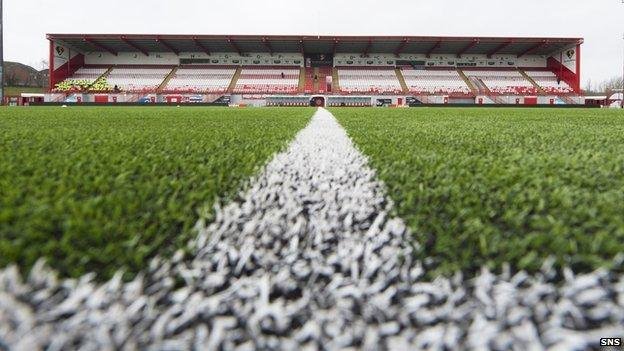
Visiting supporters notice it immediately. Scottish football has far more synthetic surfaces in its senior divisions than England does, including clubs that have played in the top flight on plastic for years. To anyone used to the Premier League’s immaculate hybrid grass, it looks like a step backwards.
It is not a mystery, and it is not a lack of ambition. The case for artificial pitches in Scotland is largely financial, partly climatic, and strong enough that several clubs have stuck with them through sustained criticism.
The weather is the starting point
Scotland gets a lot of rain, a fair amount of frost and relatively little growing season. A grass pitch in that climate needs enormous support to survive forty home games a year: drainage, undersoil heating, lighting rigs to encourage growth in winter, and a full-time grounds team.
That package costs a great deal to install and a great deal to run, and the clubs most exposed to the weather are generally the ones least able to afford it. Without it, a grass pitch in a wet Scottish winter deteriorates to the point where matches get called off, and postponements cost money twice — in lost gate receipts and in a fixture pile-up later.
Why does community use matter so much?
This is the part that gets missed. A grass pitch at a small Scottish club can take perhaps two matches a week and nothing else. An artificial pitch can take forty hours of use a week without noticeable damage.
That changes a club’s business model completely. The pitch becomes a facility that generates income seven days a week — youth teams, women’s football, amateur leagues, schools, five-a-side hire — rather than a cost centre used for ninety minutes a fortnight. For a club in the lower divisions, that revenue can be the difference between surviving and not.
It also means the first team trains at the stadium rather than renting somewhere else, and the academy plays on the same surface the senior side does. Several Scottish clubs have been explicit that the pitch paid for itself in facility hire within a few years.
Who actually uses them
Artificial surfaces have been used at every level of the Scottish professional game, including the Premiership. Livingston and Hamilton Academical are the long-standing examples in the top flight, and plenty of Championship and League One clubs have followed. Kilmarnock installed one in the mid-2010s and later moved back to grass, which tells you the decision is not permanent in either direction.
In the Highland and Lowland Leagues synthetic pitches are common to the point of being unremarkable, for exactly the reasons above: small budgets, hard winters and a need to make the ground earn money all week.
Why are they so unpopular with players?
Three complaints come up consistently. The first is the way the ball behaves — a faster, truer bounce that takes adjusting to and makes a well-struck pass skid more than players expect. The second is the surface itself, which grips differently and is less forgiving on a slide or a fall. The third is recovery: players frequently report more soreness in the days after playing on plastic.
The injury question is less settled than either side claims. Studies comparing injury rates on modern third-generation surfaces with grass have generally found broadly similar overall rates, with some differences in the type of injury rather than the number. What they do not capture well is the subjective load — the feeling of having played on a harder surface — which is what players actually complain about and which affects how they train in the following days.
Players’ representative bodies have campaigned against synthetic pitches in the senior divisions for years, and the opposition is genuine rather than nostalgic. Whether the evidence supports a ban is a different question from whether players dislike them.
What a modern synthetic pitch is actually made of
The surfaces being argued about are not the plastic carpets of the nineteen-eighties, and the distinction matters. Those early pitches were short-pile nylon laid over tarmac or concrete, with almost no cushioning, and they deserved their reputation: the ball bounced absurdly high and falling on one took skin off.
A current third-generation pitch is a different product. The fibres are longer and softer, usually polyethylene, and they stand in a layer of infill — sand for stability and a rubber or cork granulate for shock absorption — sitting on an engineered shock pad and a drainage base. The whole assembly is designed to measured standards for ball bounce, ball roll, rotational resistance and force reduction, and it is tested against them.
That is why clubs can point to certification and players can still complain. The pitch meets the standard, which means it behaves within an acceptable range of grass; it does not mean it feels like grass. Newer systems using cork or organic infill have narrowed the gap further, and they are what most clubs replacing an older surface now install.
The competitive objection
The other argument against is sporting. A club that plays its home matches on plastic has a real advantage, because its players train on the surface daily while visiting sides arrive having prepared on grass. That is no different in principle from a narrow pitch or a strong wind, but it is more consistent and more pronounced.
Supporters of the pitches point out, reasonably, that the clubs using them are overwhelmingly the clubs with the least money, and that removing the advantage would mean removing the revenue that makes the club viable. That is the crux of the whole debate: it is less an argument about surfaces than an argument about the financial structure of Scottish football.
Where it is heading
Hybrid surfaces — grass reinforced with synthetic fibres — are the likely middle ground, and the larger Scottish clubs have moved that way. They play like grass, survive a Scottish winter far better than pure grass, and satisfy the players. They also cost considerably more than a synthetic pitch and cannot be hired out all week, which is why they remain out of reach for most clubs below the top division.
Until the economics change, artificial pitches will stay in Scottish senior football, because for the clubs using them the alternative is not a better pitch. It is no pitch income at all. If you are picking up a shirt before a trip north, our guide to Celtic shirts and the hoops covers what to look for.
Frequently asked questions
Are artificial pitches allowed in the Scottish Premiership?
Yes. Several clubs have played top-flight football on synthetic surfaces, provided the pitch meets the required quality standard.
Do artificial pitches cause more injuries?
The evidence is mixed. Comparisons of modern third-generation surfaces with grass have found broadly similar overall injury rates, with some differences in injury type. Players consistently report more soreness afterwards, which is a separate issue.
Why does England have so few of them?
Mainly money and rules. English top-flight clubs can afford hybrid grass and heated, drained pitches, and the professional leagues there have not permitted synthetic surfaces in the top divisions. Scotland’s smaller clubs face a different calculation, which also shapes the pyramid itself.